
16 Vastu Zones and 5 Elements — Devtas of Each Zone and What They Rule
The 45 devtas tell you who sits on each part of your house. The 16 zones and the five elements are a quicker way to read the same house by direction.
30-day protocol PDF - free download
Enter your email and get the guided template instantly.
This chapter joins the two: for every zone, its element, the devtas who fall in it, and the part of life it touches.
In simple words
- The circle around the centre of the house is cut into 16 equal zones — 22.5° each.
- Five elements: water, air, fire, earth, space.
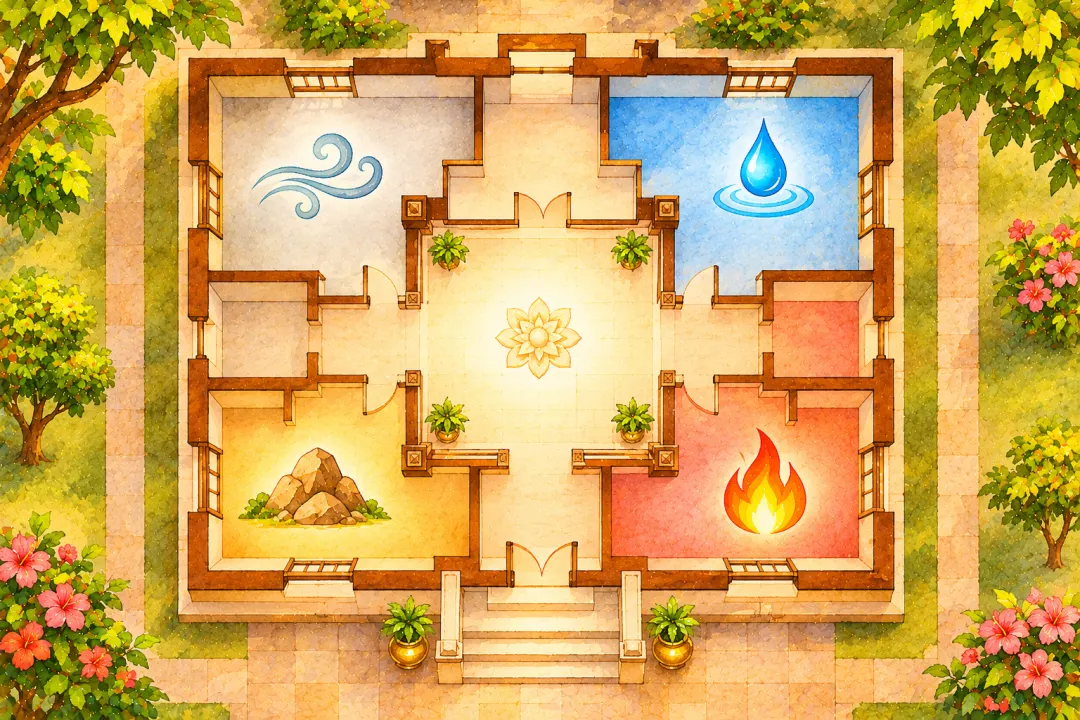
- Roughly: north-east water, south-east fire, south-west earth, north-west air, centre space.
- Each zone holds two or three of the 45 devtas.
- The 16 zones are modern practice; the 45 devtas come from the Bṛhat Saṁhitā.
A. The five elements and the four corners
Everything, says Indian thought, is made of five elements — the pañca-mahābhūta: earth, water, fire, air and space.
Vastu teaching places them on the house like this. The idea is old; the exact borders differ from school to school.
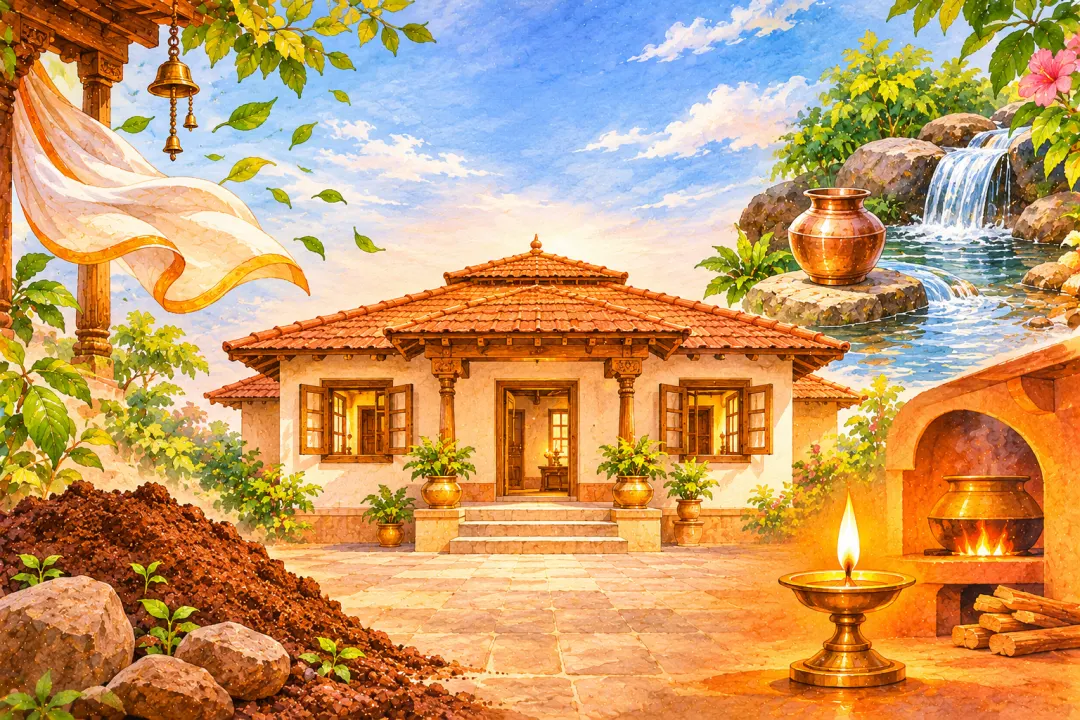
- Water — north-east and north. Cool, flowing, clear. Wells, water and prayer belong here.
- Fire — south-east and south. Heat, energy, cooking. The kitchen fire belongs here.
- Earth — south-west. Weight and steadiness. The heaviest, most solid part of the house.
- Air — north-west and east. Movement and contact. Guests, vehicles and things that come and go.
- Space — the centre and the west. Openness. The centre of the house is kept open for it.
Why this fits the Vastu Purusha
Think back to chapter 6. His head (NE) is the light, clear water corner. His feet (SW) are the heavy earth corner. His heart (centre) is open space.
The element map and the body map say the same thing in two languages.
B. The 16 zones
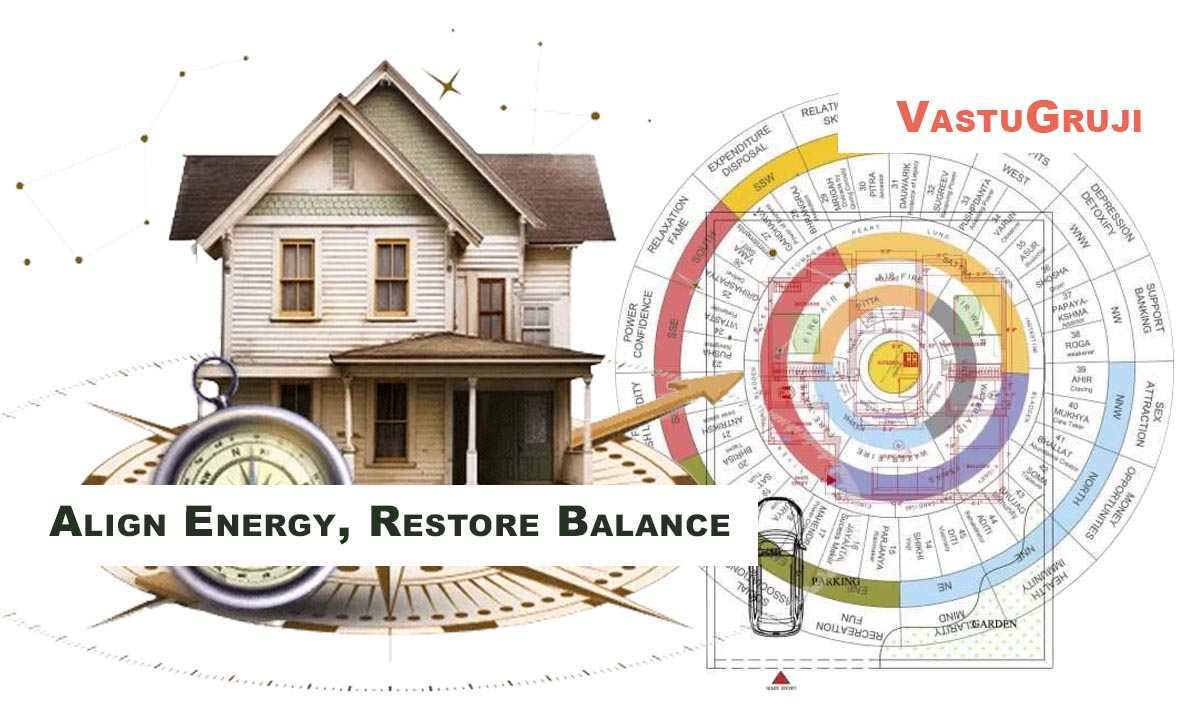
Stand at the centre of the house. Turn a full circle. Cut that circle into 16 equal slices of 22.5° each — that is the 16-zone wheel.
How to draw it
- Mark the centre (chapter 7) and true north.
- Draw the north line, then a line every 22.5° all the way round. Put the north line in the middle of the North zone — so North runs from 11.25° west of north to 11.25° east of it.
- Name the slices clockwise: N, NNE, NE, ENE, E, ESE, SE, SSE, S, SSW, SW, WSW, W, WNW, NW, NNW.
Zones and devtas together
On a square 81-pada grid, each zone has one devta at its middle and shares the two beside it with the next zones. The four main directions also take the inner devta on that side. Exact borders shift with the plot's shape, so check your own plan.
| Zone · element | Main devtas (middle one first) | What it affects in life |
|---|---|---|
| N · Water | Soma (N5) · Bhallat, Bhujag · inner: Bhudhar | New chances, customers, money coming in |
| NNE · Water | Aditi (N7) · Bhujag, Diti | Health, immunity, care in the family |
| NE · Water | Shikhi (E1) · Diti, Parjanya · inner: Aapaha, Apahvatsa | Clear mind, new ideas, prayer and focus |
| ENE · Air | Jayant (E3) · Parjanya, Mahendra | Freshness, fun, getting things moving |
| E · Air | Surya (E5) · Mahendra, Satya · inner: Aryama | Social links, government, standing in society |
| ESE · Air | Bhrisha (E7) · Satya, Antriksh | Churning and analysis; when wrong, worry |
| SE · Fire | Anil (S1) · Antriksh, Pusha · inner: Savita, Savitra | Cash in hand, energy, the cooking fire |
| SSE · Fire | Vitatha (S3) · Pusha, Grihakshat | Strength, confidence, drive |
| S · Fire | Yama (S5) · Grihakshat, Gandharva · inner: Vivaswan | Name and fame, rest, discipline |
| SSW · Earth | Bhringraj (S7) · Gandharva, Mriga | Letting go: waste, expenses, what is not needed |
| SW · Earth | Pitra (W1) · Mriga, Dauwarik · inner: Indra, Jaya | Relationships, stability, skills, family roots |
| WSW · Space | Sugreev (W3) · Dauwarik, Pushpdant | Study, knowledge, savings |
| W · Space | Varun (W5) · Pushpdant, Asur · inner: Mitra | Gains, profit, the fruit of effort |
| WNW · Space | Shosha (W7) · Asur, Papyakshma | Letting go of sadness; when wrong, low mood and habits |
| NW · Air | Roga (N1) · Papyakshma, Ahi · inner: Rudra, Rajyakshma | Support from people and banks, movement |
| NNW · Water | Mukhya (N3) · Ahi, Bhallat | Attraction, closeness between partners |
| Centre · Space | Brahma (9 padas) | Balance, goals, the whole house working together |
"What it affects" is drawn from the powers of those devtas (chapter 1) — a modern reading, not the words of the texts.
C. Reading your house with both
Use the zones for a quick look and the devtas for the fine detail. Here is a simple order:
- Element clash first. Fire in a water zone (a kitchen in the north-east) or water in a fire zone (a tank in the south-east) is the first thing teachers look for.
- Then the corner weights. Is the south-west the heaviest part? Is the north-east the lightest?
- Then the devta. Inside a troubled zone, find the exact pada and its power. A toilet on Soma (N5) and one on Bhallat (N4) are both "in the north", but they touch different things.
- Then the marmas. Check the red points from chapter 8.
How to use this chapter
- Lay the 16-zone wheel and the 81-pada grid on the same plan. The Vastu Grid tool can do both.
- Write the room in each zone next to the table above.
- For each devta in a troubled zone, read its card in chapter 5.
- Start from a problem instead — money, health, sleep — with chapter 10.
- For the right remedy for your zones, take a consultation.
Remember
- 16 zones of 22.5° each, measured from the centre of the house.
- NE water, SE fire, SW earth, NW air, centre space.
- Each zone has one devta in the middle and two shared at its edges.
- Check element clashes first, then weights, then devtas, then marmas.
- The 16 zones and element map are modern practice; the devtas are from the Bṛhat Saṁhitā.
Previous: Chapter 8 — marma points · Next: Chapter 10 — problem finder
Frequently Asked Questions
What are the 16 zones in Vastu?
The circle around the centre of the house cut into 16 equal slices of 22.5°: N, NNE, NE, ENE, E, ESE, SE, SSE, S, SSW, SW, WSW, W, WNW, NW and NNW. It is modern practice laid over the classical 45-devta grid.
Which direction is which element in Vastu?
In the scheme most widely taught: water in the north-east and north, fire in the south-east and south, earth in the south-west, air in the north-west and east, and space in the centre and west. Schools differ on the side zones.
Are the 16 zones in the Bṛhat Saṁhitā?
No. The Bṛhat Saṁhitā gives the 81-pada grid and the 45 devtas. The 16-zone wheel and the element map are later teaching.
Should I use the 16 zones or the 45 devtas?
Both. The zones give a quick overall picture; the devtas tell you exactly which power a room is touching. Start with zones, finish with devtas.
Final Professional Checklist
Tick each point while reviewing a Vastu plan or guidance page so core validation is not skipped.






Comments & Ratings
Login to leave a comment or rating.