
Chapter 8 — Marma points
Your body has tender spots — the temple, the throat, the heart. A small blow there hurts far more than anywhere else.
The Vastu Purusha lying under your house has such spots too. They are called marma. This chapter shows where they are and how to keep them safe.
In simple words
- Marmas are the points where the main grid lines and the diagonals meet.
- The most tender: the centre (the heart) and the four corners of Brahmasthāna.
- No pillar, beam, nail, heavy load or toilet on a marma.
- Tradition says: the limb of the Purusha that is hurt is where the head of the house suffers.
- If something is already there, do not panic or break walls — plan first.
A. What a marma is
The word comes from the body. In Āyurveda a marma is a vital point where life-force gathers, and where an injury is serious.
The Bṛhat Saṁhitā carries this idea onto the plan. In the same Vāstuvidyā chapter, it calls the meeting points of the main lines and the diagonals the marmas of the Vastu Purusha, and warns that they must not be hurt.
Why it matters to the family
The same chapter links his body to the people of the house. In its traditional reading: whichever limb of the Vastu Purusha is hurt, the head of the house suffers in that same limb.
That is why the limb list in chapter 2, section B is not just poetry. It is a map of where to be careful.
We give no verse numbers for these lines on purpose — the editions number this part differently, and we would rather say "the same chapter" than guess.
B. How to find the marmas on your plan
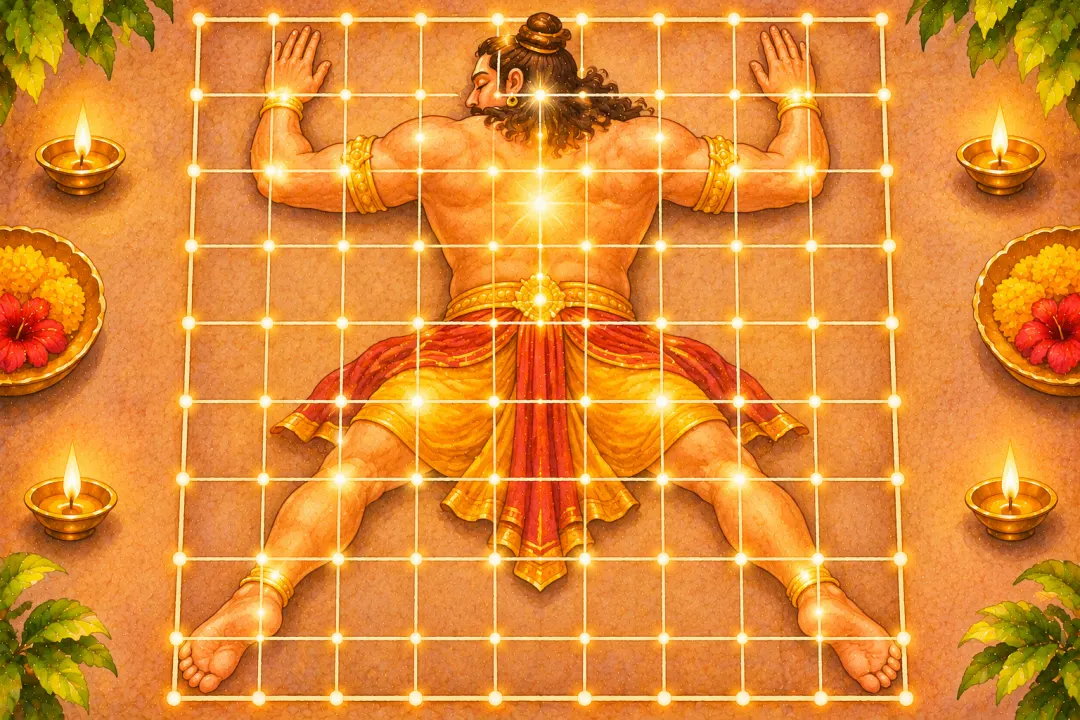
Start with the 81-pada grid from chapter 7. Then add four lines:
- The diagonal from the north-east corner to the south-west corner.
- The diagonal from the north-west corner to the south-east corner.
- The line through the centre from north to south.
- The line through the centre from east to west.
Every place where these lines cross the grid lines, or each other, is a sensitive point. Some matter much more than others.
The most important ones
In traditional teaching these come first:
- The centre point — the heart of the Purusha, under Brahma.
- The four corners of Brahmasthāna — where the diagonals cross the border of Brahma's 9 padas.
- The points where the diagonals meet the inner ring — the line between the 12 inner devtas and the 32 outer ones.
- The four corners of the house, where the diagonals end — above all the north-east, his head.
C. What not to place on a marma
The rule is simple: do not press, pierce or soil a marma.
| Do not place | Why (traditional reading) | Better |
|---|---|---|
| Pillar or column | Presses down on the point all the time | Shift it a little at the design stage |
| Beam crossing above | A line of load across a vital spot | Run the beam beside the point, not over it |
| Nail, peg, hook, drill hole | Pierces the point | Hang things a little to one side |
| Heavy load | Almirah, tank, machine or stair landing weighs on it | Keep heavy things in the south-west, off the lines |
| Toilet, septic tank, drain | Dirt on a vital spot | In our practice WCs go only in W7 (Shosha) or S7 (Bhringraj) |
| Pit, borewell, sump in the centre | A hole in the heart | Keep the centre solid, open and clean |
What is fine
- Open floor, a clean walkway, light and fresh air.
- Light furniture that can be moved.
- A courtyard or skylight over the centre — the old Indian house was built this way.
D. If one is already there
Most houses were built without anyone drawing these lines. Finding a pillar on a marma is common. It is not a reason for fear.
Do this first
- Add nothing more. No new nails, hooks or heavy items on that spot.
- Take off what is easy. Move the almirah, remove the hooks, clear the clutter.
- Keep it clean and lit. A tidy, bright spot is the gentlest care you can give.
Never do this
- Never cut a pillar or beam for Vastu. The safety of the building comes first — ask a structural engineer before any change.
- Do not dig or break floors in a hurry. A wrong fix can hurt more than the fault.
A toilet or tank on a marma, or a pillar in Brahmasthāna, needs a remedy chosen for the whole plan. That is work for a consultation, not a guess.
How to use this chapter
- Draw the two diagonals and the two centre lines on your grid. Circle the centre and Brahma's four corners in red.
- Walk through the house and note what stands on each red circle.
- See which devta's pada each point is in — chapter 5 — and what that devta's power is — chapter 1.
- Planning a new house? Mark the marmas before the structural drawing is made. It costs nothing at that stage.
- Next: which zone runs which part of life — chapter 9.
Remember
- Marma = where the grid lines and the diagonals meet (Bṛhat Saṁhitā).
- Most tender: the centre, the four corners of Brahmasthāna, and the NE corner.
- No pillar, beam, nail, load or toilet on a marma.
- If one is there: add nothing, remove the easy things, keep it clean.
- Never cut a pillar or beam; a big fault needs a consultation.
Previous: Chapter 7 — how to draw the mandala on your plan · Next: Chapter 9 — 16 zones and 5 elements
Frequently Asked Questions
What is a marma in Vastu?
A vital point of the Vastu Purusha. The Bṛhat Saṁhitā calls the meeting points of the main grid lines and the diagonals his marmas and says they must not be hurt.
Is a pillar in the centre of the house bad?
In traditional teaching the centre is the heart of the Purusha, so a pillar there is a serious fault. But never cut a pillar for Vastu — the building's safety comes first. The remedy depends on the whole plan; take a consultation.
Can I hammer a nail anywhere on the wall?
Avoid nails, hooks and drill holes on the marma lines, especially near the centre and the corners of Brahmasthāna. A little to one side is fine.
What happens if a marma is hurt?
The traditional reading of the Bṛhat Saṁhitā is that the head of the house suffers in the same limb of the body that is hurt on the Vastu Purusha. Use it as a reason for care, not for fear.