
Chapter 7 — How to draw the mandala on your own plan
You now know who the 45 devtas are and where they sit. This chapter puts them on your house.
All you need is a plan drawn to scale, a compass, a pencil and a ruler. Go step by step — the whole job takes about half an hour.
In simple words
- A home uses the 81-pada (9×9) grid.
- First find true north, then the centre of the house.
- Divide each wall into 9 equal parts — 10 lines each way.
- Write the 32 outer devtas clockwise, starting with Shikhi at the north-east corner.
- In the middle: Brahma's 9 padas, with 12 inner devtas around him.
A. Two grids: 64 padas and 81 padas
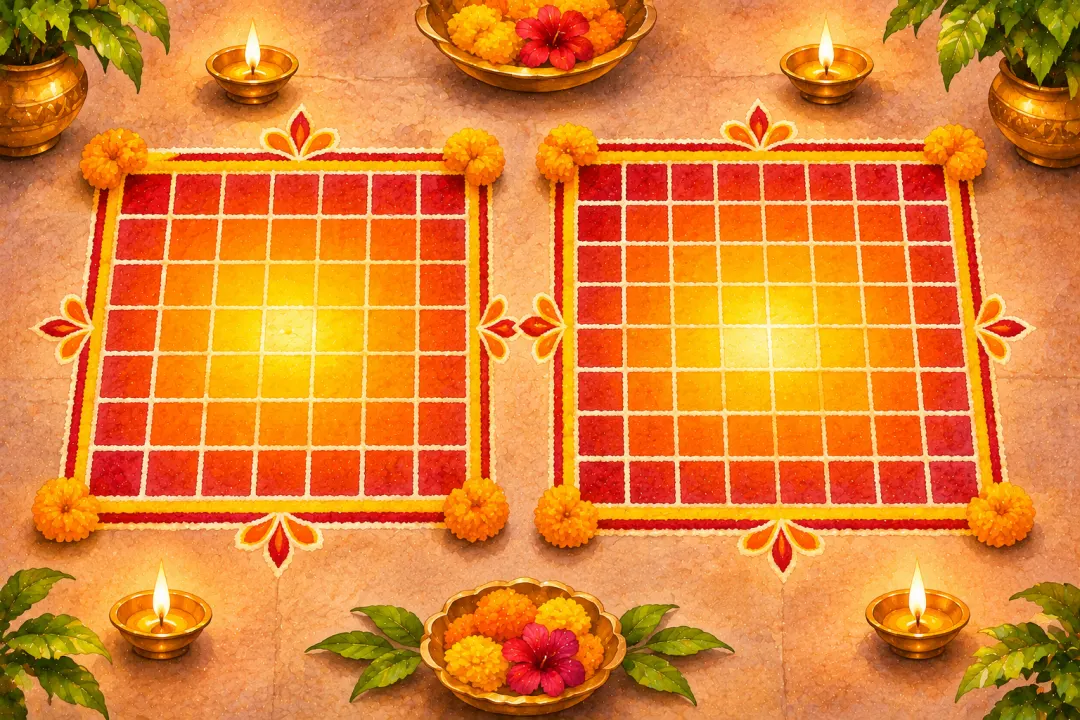
A pada is one square of the grid. The old books know many grid sizes, but two matter most.
The 81-pada grid — Paramaśāyika
Nine squares by nine. This is the grid of the Bṛhat Saṁhitā: "in the division into eighty-one, ten lines each way; thirteen gods within, thirty-two outside" (52.42, quoted in chapter 2).
Brahma takes the middle 3×3 = 9 padas. Every map on this site, and the Vastu Grid tool, uses this grid.
The 64-pada grid — Maṇḍūka
Eight squares by eight. Brahma takes the middle 2×2 = 4 padas. The Bṛhat Saṁhitā mentions this layout too, in its door verses (52.69).
Later manuals such as the Mayamata and the Mānasāra describe many grids. In common practice the 64-pada grid is used mostly for temples and the 81-pada grid for homes.
| 64 padas — Maṇḍūka | 81 padas — Paramaśāyika | |
|---|---|---|
| Grid | 8 × 8 | 9 × 9 |
| Lines each way | 9 | 10 |
| Brahma in the centre | 4 padas | 9 padas |
| Mostly used for | Temples (common practice) | Homes, shops, offices |
B. Find true north
Every devta's place depends on north. If north is wrong by a lot, every pada moves. So take care here.
Use the compass the right way
- Stand inside the house, at least a metre from iron grills, steel almirahs, cars, the fridge and wiring.
- Hold the compass (or phone compass) flat. Calibrate the phone first by moving it in a figure-8.
- Take three readings in three different rooms. If they agree within a few degrees, use their average.
- Draw a north arrow on your plan. Note the angle between north and the nearest wall.
Magnetic north and true north
A compass shows magnetic north. True north differs by the "declination". In most of India this gap is small, about a degree or two — check the current value for your city online if you want exact work.
The old way: the shadow stick
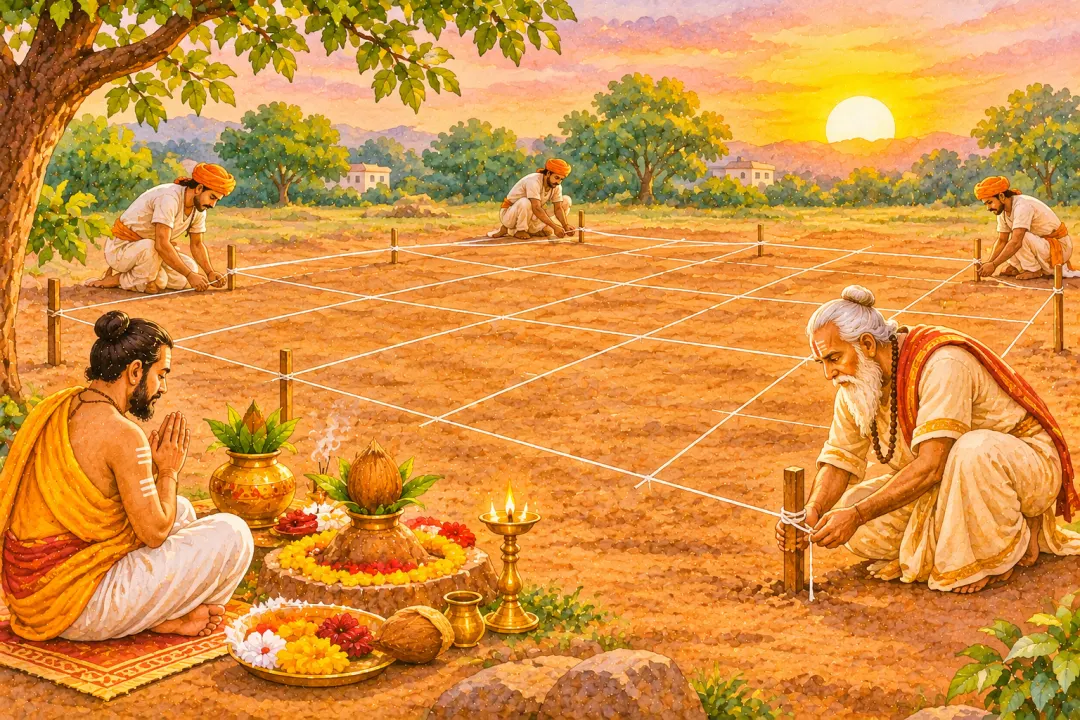
The old manuals find east without any compass. A straight stick (śaṅku) is set upright on level ground. The tip of its shadow is marked in the morning and again in the afternoon, when the shadow has the same length.
The line joining the two marks runs east–west. It is a lovely check on a sunny day.
C. Find the centre and draw the grid
The grid is drawn along the outer walls of the house, with Brahma at its centre. So the centre comes first.
A square or rectangle
Draw the two diagonals, corner to corner. Where they cross is the centre.
An odd-shaped plot
- Balance method: stick the plan on thin card, cut it out along the outer walls, and balance it on a pin. The balance point is the centre.
- Box method: split the plan into rectangles, find each one's centre, and take their average weighted by area.
- Whether a small cut or bulge counts as part of the house is a judgement call. That is best settled in a consultation.
Draw the 81 squares
- Mark the four outer corners of the house.
- Divide each wall into 9 equal parts.
- Join the marks across: 10 lines one way, 10 the other (the two outer walls count as lines).
- Check that the middle 3×3 block sits on your centre point. That block is Brahmasthāna.
Write in the 45 devtas
Start at the north-east corner and go clockwise, as Bṛhat Saṁhitā 52.43–45 does:
- East wall, north to south: E1 Shikhi, E2 Parjanya, E3 Jayant, E4 Mahendra, E5 Surya, E6 Satya, E7 Bhrisha, E8 Antriksh.
- South wall, east to west: S1 Anil, S2 Pusha, S3 Vitatha, S4 Grihakshat, S5 Yama, S6 Gandharva, S7 Bhringraj, S8 Mriga.
- West wall, south to north: W1 Pitra, W2 Dauwarik, W3 Sugreev, W4 Pushpdant, W5 Varun, W6 Asur, W7 Shosha, W8 Papyakshma.
- North wall, west to east: N1 Roga, N2 Ahi, N3 Mukhya, N4 Bhallat, N5 Soma, N6 Bhujag, N7 Aditi, N8 Diti.
- The 13 inside: Brahma in the centre; Aryama (E), Vivaswan (S), Mitra (W), Bhudhar (N) beside him; and the inner corners — Aapaha and Apahvatsa (NE), Savita and Savitra (SE), Indra and Jaya (SW), Rudra and Rajyakshma (NW).
Copy the exact shapes from the map in chapter 5, or let the Vastu Grid tool draw it for you.
D. A worked example
Take a house 36 ft wide (west to east) and 45 ft deep (north to south). Its walls face the four directions squarely, and the front is on the east.
Size of one pada
- Along the north and south walls: 36 ÷ 9 = 4 ft.
- Along the east and west walls: 45 ÷ 9 = 5 ft.
- Brahmasthāna = 3 × 3 padas = 12 ft × 15 ft: from 12 ft to 24 ft measured from the west wall, and from 15 ft to 30 ft measured from the north wall.
Where things land
| Pada | Where, measured from which corner | What it tells us |
|---|---|---|
| E3 Jayant | East wall, 10–15 ft from the NE corner | ✓ Good for the main door |
| E4 Mahendra | East wall, 15–20 ft from the NE corner | ✓ Good for the main door |
| E5 Surya | East wall, 20–25 ft from the NE corner | Exact east; door here is not on the good list |
| Brahma | 12–24 ft from the west wall, 15–30 ft from the north wall | Keep open and light |
| W1 Pitra | West wall, 0–5 ft from the SW corner | The feet — a good place for weight |
So the main door should start at least 10 ft and end within 20 ft from the north-east corner, along the east wall. Door results for every pada are in chapter 4.
How to use this chapter
- Draw your own grid once by hand — you will understand your house far better than from any app.
- Then check it with the Vastu Grid tool guide.
- Next, mark the danger spots on the same grid: chapter 8 — marma.
- Then read your grid zone by zone: chapter 9.
- Odd plot, tilted walls or many cuts? Send the plan for a consultation guide.
Remember
- Home = 81 padas (9×9), Brahma 9. Temples often use 64 (8×8).
- Take north with a compass in three places, away from metal.
- Centre: diagonals for a rectangle; the balance point for an odd plot.
- Nine equal parts per wall; start at Shikhi (E1) in the NE and go clockwise.
- Write every measurement from a named corner or wall.
Previous: Chapter 6 — the story of the Vastu Purusha · Next: Chapter 8 — marma points
Frequently Asked Questions
Should I use the 64-pada or the 81-pada grid for my house?
The 81-pada (9×9) grid. It is the grid of the Bṛhat Saṁhitā (52.42), and in common practice it is used for homes, while the 64-pada Maṇḍūka is used mostly for temples.
Can I use my phone's compass for Vastu?
Yes, if you calibrate it and keep it away from metal. Take readings in three rooms and use the average. In most of India the gap between magnetic and true north is only a degree or two.
How do I find the centre of an irregular plot?
Cut the plan out of card and balance it on a pin — the balance point is the centre. Or split it into rectangles and take their area-weighted average. Whether a small cut or extension counts is best decided in a consultation.
Do I draw the grid on the plot or on the house?
Both can be read. For daily living the house's outer walls are used; the plot grid matters for gates, boundary walls and open land.