
The Story of the Vastu Purusha — Birth, the Devtas and the Boon
Every chapter so far has spoken of the 45 devtas sitting on the body of the Vastu Purusha. But who is he, and why does he lie under every house?
30-day protocol PDF - free download
Enter your email and get the guided template instantly.
This chapter tells his story the way the old books tell it — and marks clearly where the books stop and later teaching begins.
In simple words
- The Vastu Purusha was a giant being who covered earth and sky.
- The devtas caught him, pressed him face down and sat on him.
- Brahma made him the "Vastu-nara" — the being of every plot of land.
- His head is in the north-east and his feet in the south-west.
- That is why he is worshipped before the foundation, the door and the house-warming.
A. The being who blocked heaven and earth — Bṛhat Saṁhitā
Varāhamihira opens his Vāstuvidyā chapter not with rules, but with a story. It is only two verses long.
किमपि किल भूतमभवद्रुन्धानं रोदसी शरीरेण ।
तदमरगणेन सहसा विनिगृह्याधोमुखं न्यस्तम् ॥
यत्र च येन गृहीतं विबुधेनाधिष्ठितः स तत्रैव ।
तदमरमयं विधाता वास्तुनरं कल्पयामास ॥
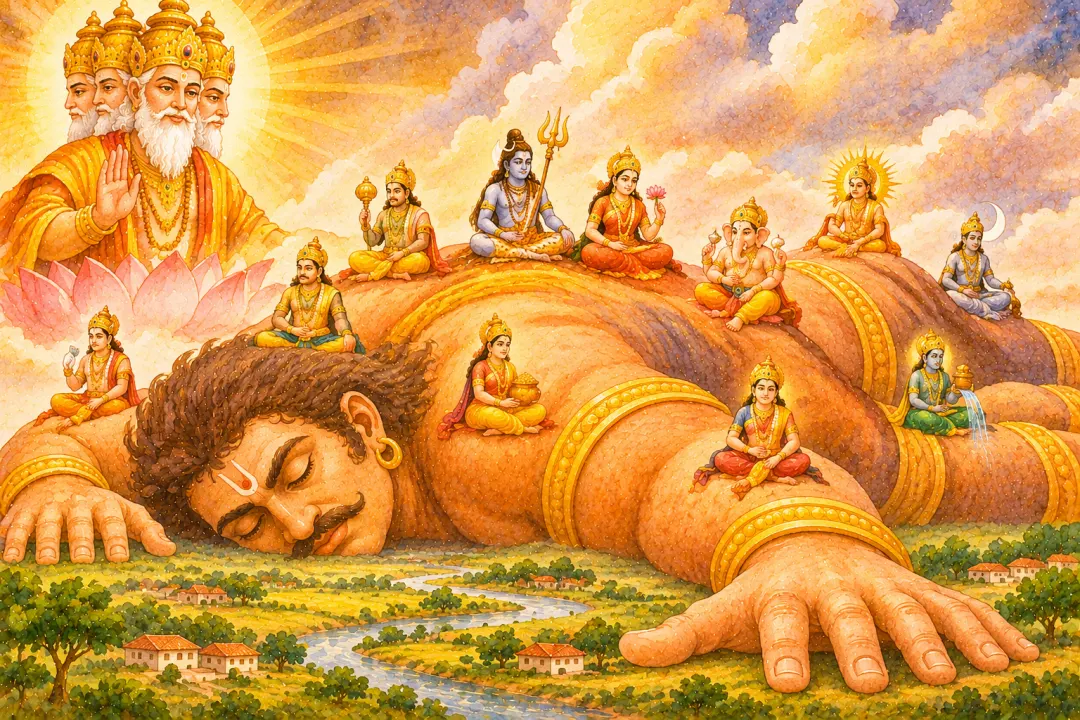
Meaning: It is said there was once some being that blocked heaven and earth with its body. The host of gods suddenly seized it and laid it face down. Wherever a god had seized it, there that god stayed seated. The Creator made that being, now made of gods, the Vāstu-nara (the man of the site).
हिंदी: कहते हैं, एक कोई प्राणी था जिसने अपने शरीर से धरती और आकाश दोनों को रोक लिया। देवताओं के समूह ने उसे अचानक पकड़कर मुँह के बल नीचे रख दिया। जिस देवता ने उसे जहाँ से पकड़ा, वह वहीं बैठा रहा। विधाता (ब्रह्मा) ने उस देवमय प्राणी को “वास्तुनर” बना दिया।
What these two verses tell us
- He has no name at first — the text just says "some being" (kim api bhūtam).
- He was huge — big enough to block earth and sky.
- The gods laid him face down. This is why every later text says he lies "avāṅmukha", face to the ground.
- Each god stayed where he held him. This one line is the seed of the whole 45-devta map.
- Brahma, the Creator, turned him into the being of the site. So the mandala is not a drawing on top of the land — it is the land.
B. The fuller story — Matsya Purāṇa
The Matsya Purāṇa (chapter 252, at the start of its Vastu chapters 252–256) gives a longer telling. Below it is retold in plain words. Details differ a little between editions and retellings, so read it as the Purāṇa's story, not as a list of exact verses.
Born from a drop of sweat
Long ago, Lord Śiva fought the asura Andhaka. In the heat of that battle, drops of sweat fell from Śiva's brow onto the earth.
From those drops rose a fearsome being with a wide-open mouth. He drank the blood of the fallen asuras, and still he was hungry.
The hunger that wanted the three worlds
The being then did hard tapas to Śiva. Pleased, Śiva offered him a boon. He asked for the power to swallow all three worlds.
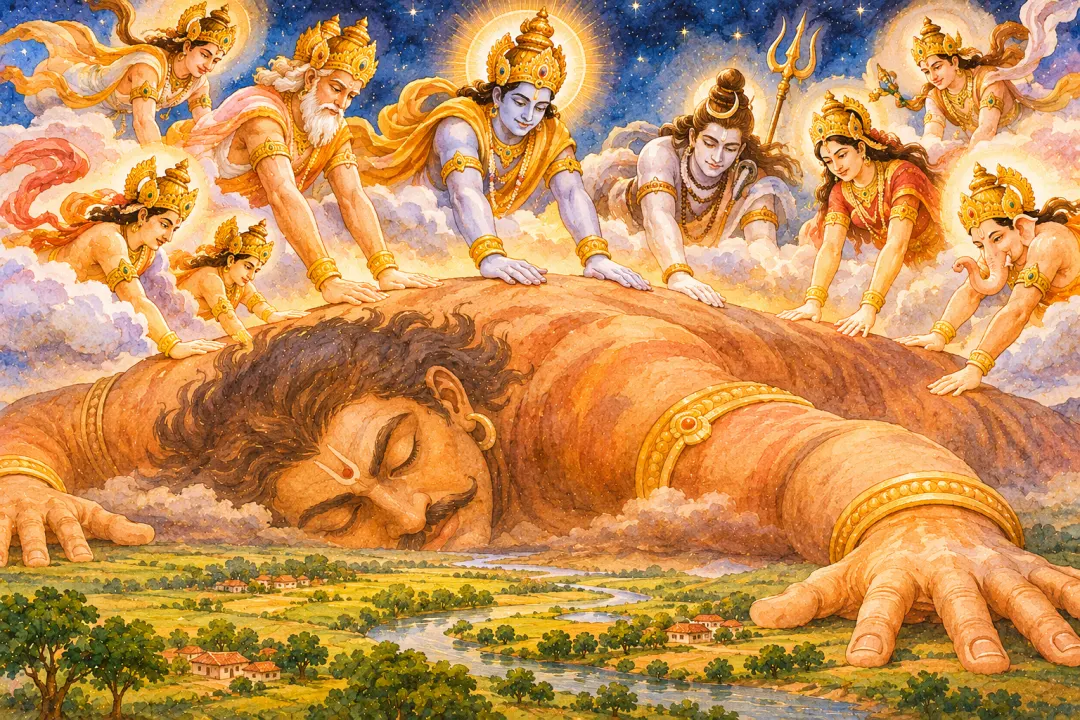
He began to grow. His body spread over the earth and up to the sky. The devtas grew afraid.
The devtas press him down
Together the devtas caught him and threw him down on the earth, face down. Each held him at one place and sat there, so he could not rise.
Because the devtas came to dwell (vas) on him, he was called Vāstu.
Brahma's boon
Lying under the weight of the devtas, the Vastu Purusha cried out: "What wrong have I done? Why am I held down?"
In the common telling it is Brahma who calms him. (The Bṛhat Saṁhitā, above, also names the Creator — vidhātā — as the one who made him the Vāstu-nara.) He is given a place of honour in return:
- Wherever a house, village, town, temple, well or garden is built, he will be worshipped first.
- The offerings made at that time are his share.
- Those who build without honouring him will meet obstacles in that building.
So the being who wanted to swallow the world became its quiet keeper. He still lies under every plot, held by the 45, and he is fed with respect instead of fear.
C. Why his head is north-east and his feet south-west
The direction comes straight from the text. The same chapter of the Bṛhat Saṁhitā that told the story gives his posture:
पूर्वोत्तरदिग्मूर्धा पुरुषोऽयमवाङ्मुखोऽस्य शिरसि शिखी ।
Meaning: This Purusha lies face down with his head towards the north-east; on his head sits Shikhi.
हिंदी: यह पुरुष ईशान (उत्तर-पूर्व) की ओर सिर किए, मुँह नीचे किए लेटा है; इसके सिर पर शिखी है।
Head in the north-east means the feet are at the opposite corner, the south-west. The heart is at the centre, under Brahma. The verses after 52.51 place each devta on a limb — the full list is in chapter 2, section B.
The main points of his body
| Part of the body | Where on the plan | Devta on it |
|---|---|---|
| Head | North-east corner | Shikhi (E1) |
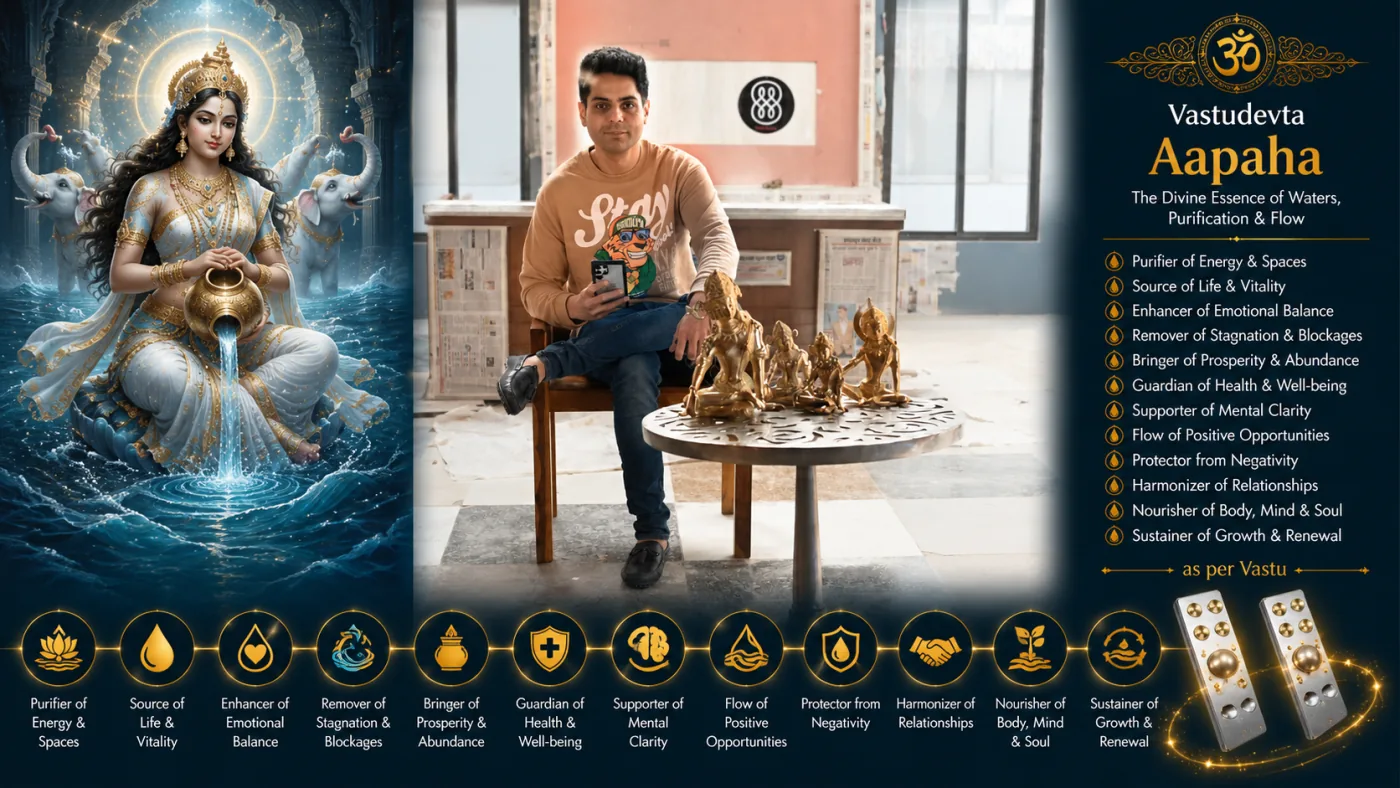
| Mouth | Just inside the NE corner | Aapaha |
| Eyes and ears | Near NE, on the north and east sides | Parjanya, Jayant · Diti, Aditi |
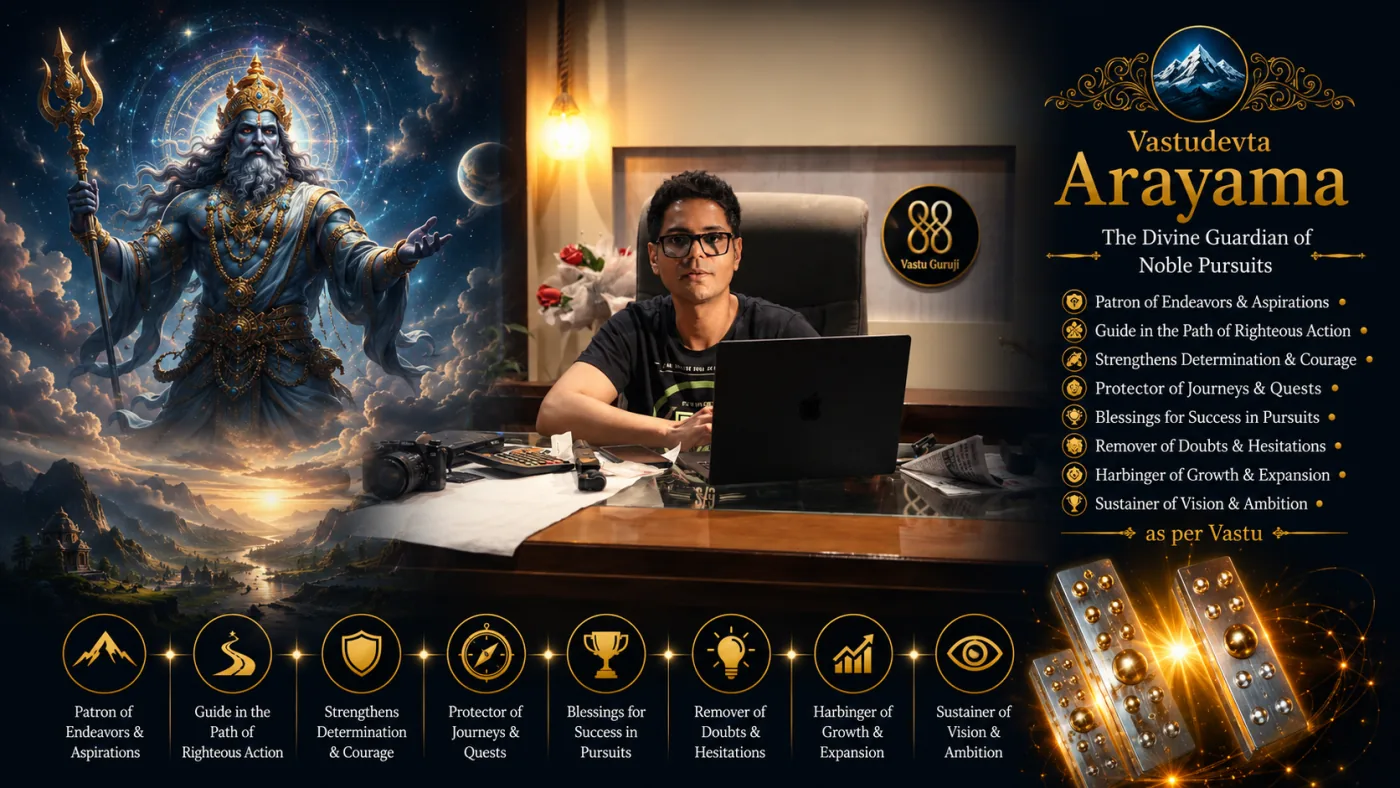
| Chest and breast | Inner NE and east | Apahvatsa, Aryama |
| Heart | Centre | Brahma |
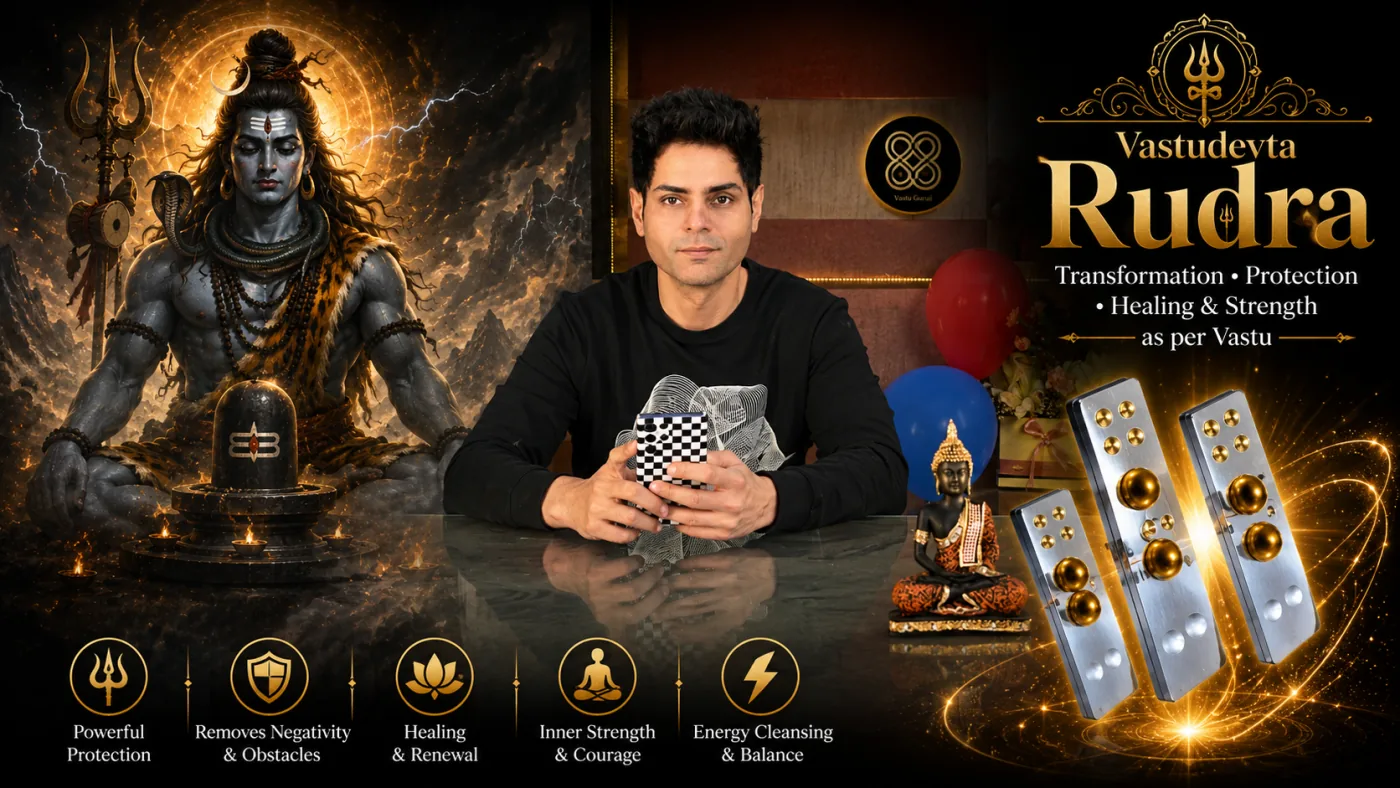
| Hands | Inner SE and NW | Savita, Savitra · Rudra, Rajyakshma |
| Belly | Inner south and west | Vivaswan, Mitra |
| Feet | South-west corner | Pitra (W1) |
What this means for a home (later teaching)
The texts give the posture. What follows is how Vastu teachers read it — useful, but interpretation:
- Head (NE) light and open — a head should not carry a heavy load.
- Feet (SW) firm and heavy — a body stands steady on its feet.
- Heart (centre) free — nothing should press on the heart.
D. Why he is worshipped before building
The boon is the reason. He lies under the land before any wall goes up, so he is greeted first. In traditional practice, Vastu worship is done at these moments:
- Bhūmi-pūjan — before the ground is first dug.
- Śilānyāsa — when the foundation stone is laid.
- Fixing the main door frame — the house's mouth is set.
- Gṛhapraveśa — before the family moves in.
- Big changes — breaking walls or adding floors to a lived-in house.
How to use this chapter
- Before you read any rule, picture him: head NE, feet SW, heart in the centre. Most Vastu rules follow from that one picture.
- Want to see which devta sits where? Go back to the map in chapter 5.
- Ready to lay him on your own plan? That is chapter 7.
- Which spots of his body must never be hurt — the marmas — is chapter 8.
- Building or moving in soon? A consultation fixes the right dates and steps for your plot.
Remember
- Bṛhat Saṁhitā: a giant being, pressed face down by the gods, made the Vāstu-nara by Brahma.
- Matsya Purāṇa: born of Śiva's sweat, hungry, did tapas, got the boon of worship.
- He is called "Vāstu" because the devtas dwell on him.
- Head NE, feet SW, heart in the centre — Bṛhat Saṁhitā 52.51.
- He is worshipped at bhūmi-pūjan, the foundation, the door and gṛhapraveśa.
Previous: Chapter 5 — the 45 devtas one by one · Next: Chapter 7 — how to draw the mandala on your plan
Frequently Asked Questions
Who is the Vastu Purusha?
The being of the site. The Bṛhat Saṁhitā says a huge being blocked heaven and earth, the gods pressed him face down and each stayed where he held him, and the Creator made him the Vāstu-nara. The 45 devtas of the mandala are those gods.
Was the Vastu Purusha born from Shiva's sweat?
That is the Matsya Purāṇa's telling (chapter 252): sweat from Śiva's brow during the fight with Andhaka became the being. The Bṛhat Saṁhitā does not tell his birth; it only says "some being" existed.
Why does the Vastu Purusha lie with his head in the north-east?
Bṛhat Saṁhitā 52.51 says so directly: he lies face down with his head to the north-east, and Shikhi sits on his head. His feet are therefore at the south-west and his heart at the centre.
Is Vastu Purusha the same as Vastu Devta?
People often use the two names for the same being. Strictly, the Vastu Purusha is the one lying on the plot, and the 45 devtas are the gods seated on his body.
Must I do Vastu puja before building a house?
Tradition says yes — at bhūmi-pūjan, the foundation, the main door and gṛhapraveśa. The exact rite follows your family and regional custom. For the right timing and steps for your plot, take a consultation.
Final Professional Checklist
Tick each point while reviewing a Vastu plan or guidance page so core validation is not skipped.


Comments & Ratings
Login to leave a comment or rating.